
Jubilee Year of St. Francis

Experience Great Franciscan Event

St. Francis of Assisi holds profound significance in the Catholic faith as a giant of holiness and founder of the Franciscan Order, whose life embodied radical poverty, a love for all of creation and the promotion of peace.

 
Pope Leo XIV designated 2026 as a Jubilee Year in honor of St. Francis, on the 800th anniversary of his death, to be observed from Jan. 10, 2026, to Jan. 10, 2027. In his letter announcing the jubilee, the Pope hoped that St. Francis’ “message of peace may find a profound echo in the Church and society today.”

Jubilee Year at the Diocese

Immaculate Conception
2540 San Diego Ave.,
San Diego, CA 92110

Mission Basilica San Diego de Alcalá
10818 San Diego Mission Rd.,
San Diego, CA 92108

Old Mission San Luis Rey
4050 Mission Ave.,
Oceanside, CA, 92057

San Luis Rey Parish
4070 Mission Ave.,
Oceanside, CA 92057

St. Anthony of Padua
210 W 7th St,
Imperial, CA 92251

St. Didacus
4772 Felton St.,
San Diego, CA 92116

St. Francis Chapel at the Mission San Diego de Alcalá
10818 San Diego Mission Rd.,
San Diego, CA 92108

St. Francis of Assisi
525 W. Vista Way, Vista, CA 92083

Upcoming Events

Jun 9-Sept 1

Basic Catechist Formation Certification (English)

25

Apr

Misa Adaptada a las Necesidades Sensoriales

6

May

Evangelizando en un Mundo Digital

Diocesan Pilgrimage Destinations

Some of our parishes are planning pilgrimages during the Jubilee Year to celebrate this special period. 
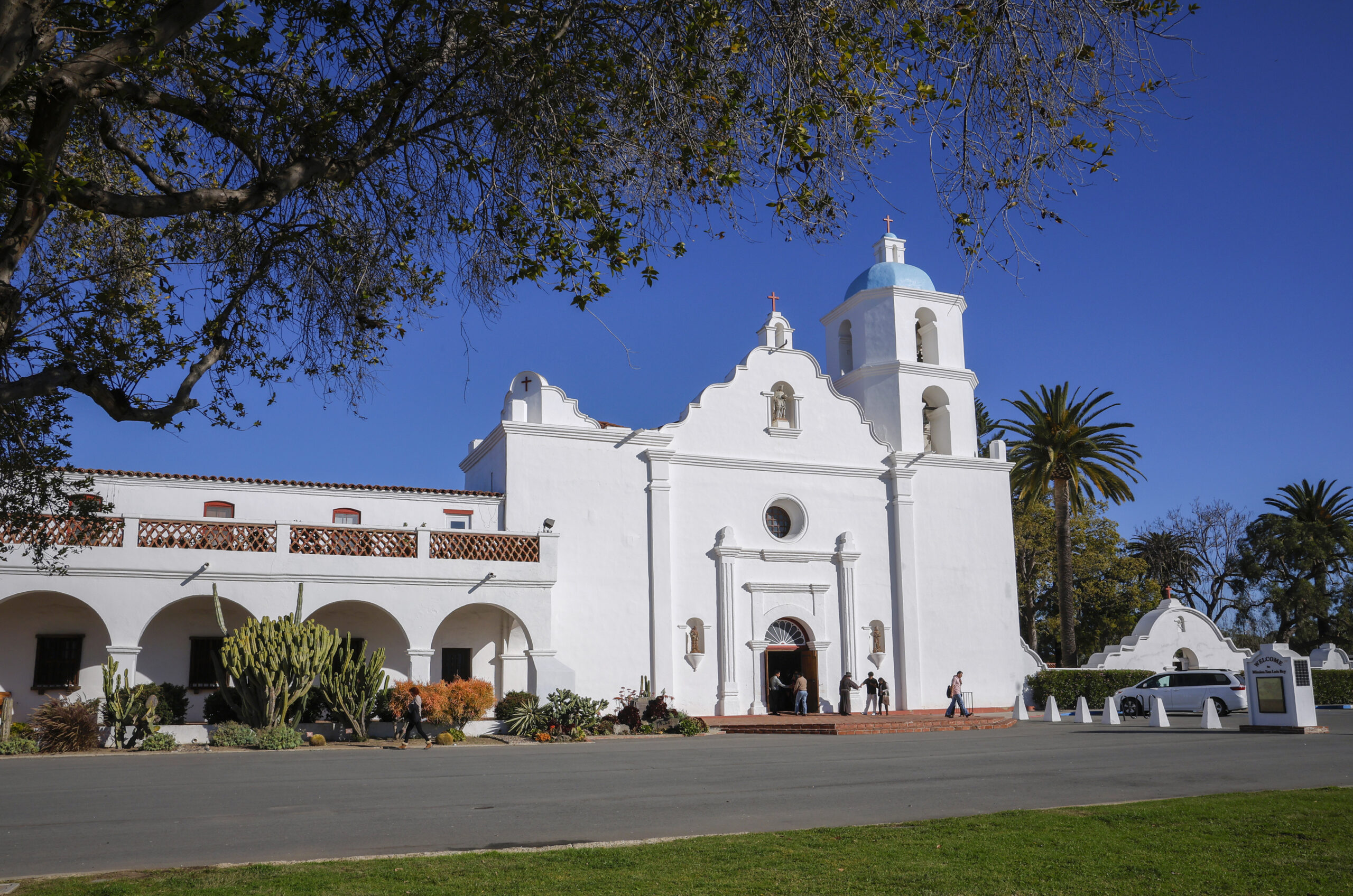
Mission San Luis Rey

Pope Leo XIV's Jubilee Year Prayer

Saint Francis, our brother,
you who 800 years ago,
went to meet Sister Death as a man at peace,
intercede for us before the Lord.

You recognized true peace in the Crucifix of San Damiano,
teach us to seek in Him the source of all reconciliation that breaks down every wall.

You who, unarmed,
crossed the lines of war and misunderstanding,
give us the courage to build bridges
where the world raises up boundaries.

In this time afflicted by conflict and division,
intercede for us
so that we may become peacemakers:
unarmed and disarming witnesses
of the peace that comes from Christ.

Amen

About the Coat of Arms

Bishop Pulido’s coat of arms is divided into four quarters with wavy horizontal lines from top to bottom. The blue and white lines represent the Blessed Virgin Mary. They also suggest water, which alludes to Jesus washing the feet of His disciples and to the waters of baptism. The red and gold lines represent the Holy Spirit and fire. The colors also can be seen as referring to the Blood that (along with water) poured from Jesus’ side at His crucifixion, as well as to the bread (gold) and wine (red) transformed into the Eucharist. At the center is a roundel featuring a symbolic representation of the “mandatum” (washing of the feet), which he believes exemplifies service to all humanity. The roundel’s outer edge is a line composed of small humps; it is borrowed from the coat of arms of the Diocese of Yakima, where Bishop Pulido served as a priest before being named a bishop.

About the Coat of Arms

Bishop Pham’s coat of arms combines the Diocese of San Diego’s coat of arms on the left side, and his on the right. On his, a red boat on a blue ocean sits on diagonal lines suggesting a fisherman’s net. This symbolizes his ministry as a “fisher of men,” as well as how his own father had been a fisherman. The boat is also a symbol of the Church, which is referred to as the “barque of Peter.” At the center of the sail is a red beehive (a symbol of the bishop’s baptismal patron saint, St. John Chrysostom, known as a “honey-tongued” preacher). The beehive is surrounded by two green palm branches (an ancient symbol of martyrdom; the bishop’s ancestors were among Vietnam’s first martyrs). The eight red tongues of fire around the boat are a symbol of the Holy Spirit and a representation of the diversity of ethnic communities.

About the Coat of Arms

The coat of arms combines symbols that reflect Bishop Bejarano’s spiritual life and priestly ministry. The main part of the shield shows four wavy vertical lines on a gold background. These represent flowing waters. This alludes to his chosen motto and also symbolizes the graces that come from the Divine life to quench our thirst for God. The upper third of the shield is red because it is borrowed from the coat of arms of the Order of Mercy, of which the Bishop’s patron saint, Raymond Nonnatus, was a member. The central symbol resembles a monstrance because St. Raymond is often depicted holding one. The Eucharist is Bishop Bejarano’s inspiration for his vocation. It was through the Eucharist that he received his call to the priesthood at age seven and which keeps his faith and his ministry going. It represents the call to offer oneself as a living sacrifice. The monstrance is flanked on either side by an image of the Sacred Heart, alluding to the mercy of God and echoing the idea of a sacrificial offering of oneself united to the sacrifice of Christ, and of a rose for Our Lady. It is an allusion to Our Lady of Guadalupe, patroness of the Americas, and highlights the bishop’s Hispanic heritage.

Topics